welcome to multiple strands

a place to converse, virtually, on a variety of topics, bringing together multiple strands to encourage, question, challenge, ponder, and edify. A cord of three strands is not quickly torn apart. (Eccl. 4.12)

Monday, April 27, 2020

A Hymn to the Evening

Soon as the sun forsook the eastern main
The pealing thunder shook the heav’nly plain;
Majestic grandeur! From the zephyr’s wing,
Exhales the incense of the blooming spring,
Soft purl the streams, the birds renew their notes,
And through the air their mingled music floats.
Through all the heav’ns what beauteous dyes are spread!
But the west glories in the deepest red;
So may our breasts with every virtue glow,
The living temples of our God Below!
Fill’d with the praise of him who gives the light,
And draws the sable curtains of the night,
Let placid slumbers soothe each weary mind,
At morn to wake more heav’nly, more refin’d;
So shall the labors of the day begin
More pure, more guarded from the snares of sin.
Night’s leaden scepter seals my drowsy eyes,
Then cease, my song, till fair Aurora rise.

—Phillis Wheatley, the first published African American poet. On December 21, 1767, the fourteen-year-old Wheatley had her first poem published in the Newport (Rhode Island) Mercury. This amazing achievement came only six years after her arrival in America, without any prior knowledge of the English language.


Sunday, March 29, 2020

The slavery of the city

How close is the relationship between ancient cities and idols - gods made by men - because they bear the same names. ... it is all intended to seduce men, to keep them from carrying out to the end the search implanted in their heart (Rev. 18.23).  There man ceases his wandering and doubt, satisfied not to leave the city in his search for genuine meaning and fulfillment. There he finds a world which he thinks fits him, a closed world where all his needs and aspirations are apparently satisfied, a world where he can afford to rest, where he has found certainty. But all the city's seductions, all the satisfactions she offers, are in fact complete slavery for men, and slavery of the most ignominious sort. ... All the inhabitants of the city are destined sooner or later to become prostitutes and members of the proletariat. ... And a remarkable slavery it is since already we see him subject to the power of money and luxury.

The Meaning of the City, Jacques Ellul, p. 54-55

Saturday, March 28, 2020

All that is Gold

All that is gold does not glitter,
Not all those who wander are lost;
The old that is strong does not wither,
Deep roots are not reached by the frost.

From the ashes a fire shall be woken,
A light from the shadows shall spring;
Renewed shall be blade that was broken,
The crownless again shall be king.

- J. R. R. Tolkien

Monday, March 23, 2020

The Use of the Past

In times of change and danger when there is a quicksand of fear under men’s reasoning, a sense of continuity with generations gone before can stretch like a lifeline across the scary present and get us past that idiot delusion of the exceptional Now that blocks good thinking.

- John Dos Passos, 1941, in “The Use of the Past”

Monday, February 3, 2020

Stewardship


Everyone to whom much was given, of him much will be required, and from him to whom they entrusted much, they will demand the more.
Luke 12:48 (ESV)

After speaking several parables and teaching about money and wealth, Jesus summarizes the thoughts with this statement. It is more expansive: stewardship is not only concerning money, though it includes money. It is also gifts, abilities, time, physical abilities, leadership, talents, etc. 

What "much" have we been given, each of us individually and collectively, for which we are compelled to be good stewards?

Wednesday, January 8, 2020

fides quaerens intellectum

‘faith seeking understanding’ (Anselm). 

That's a wonderful statement! 
Fides quaerens intellectum means "faith seeking understanding" or "faith seeking intelligence". It is the theological method stressed by Augustine (354–430) and Anselm of Canterbury (c. 1033 – 1109) in which one begins with belief in faith and on the basis of that faith moves on to further understanding of Christian truth. Anselm uses this expression for the first time in his Proslogion (II–IV). It articulates the close relationship between faith and human reason. This is the key to Anselm's theological thought and philosophical thinking. He would understand all things in faith. It means to understand intellectually what we already believe. Chronologically, faith precedes understanding, like when small children first trust their parents and believe what they state, and it is only later on, when they grow up, that they want to examine and understand the reality by themselves. In the words of Anselm of Canterbury : "Neque enim quaero intelligere ut credam, sed credo ut intelligam" ("I do not seek to understand in order that I may believe, but rather, I believe in order that I may understand").
(en.wikipedia.org/wiki/Fides_quaerens_intellectum)

x

Monday, December 30, 2019

Benedict Option or Jeremiah Option?

Links to old articles, I started writing in 2014!
  
What do you think?  What impact does this have on the church, and on Christ's kingdom?


www.theamericanconservative.com/articles/benedict-option


ZvonimirAtletic / Shutterstock.com


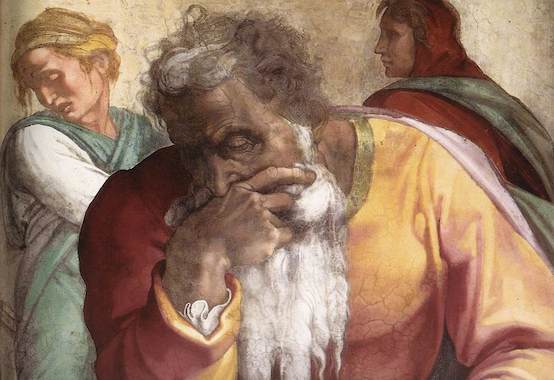
www.theamericanconservative.com/articles/what-would-jeremiah-do


Sistine Chapel, prophet Jeremiah / Wikimedia Commons

Rage at death

“It is essential to grasp the theological point that stands at the heart of our lostness, and therefore of our redemption: death is, finally, the result of our sin, and therefore rage directed against God, as if he were unfair for passing the sentence that our sin deserved, is inherently foolish, as foolish as criticizing a judge for passing a just sentence on a bank robber. Our rage is better directed at the ugliness of death, the wretchedness of sin, our sense of betrayal and self-betrayal. It may be a venting of our profound loss and frustration. But thoughtful Christians will never lose sight of the origins of death, and therefore will not, at least on this ground, rage against God himself.”

- D. A. Carson, How Long Oh Lord?  http://ref.ly/o/howlonglord/225520 
As I reflect back on 2019, and the entire decade (which really does not end this year, but that's another issue!), I am reminded of the failures of leaders ... and of us all.  This video clip is a good approach to reconciling how we live in light of God's Gospel.


How John Piper Processes the Moral Failures of His Historical Heroes from The Gospel Coalition on Vimeo.


Thursday, December 26, 2019

sex, cosmology, and the future of the West


Stepping back in time, these words from Dreher and The Economist have gained even more significance through time. In what state do we find American culture in this one issue? Father, please forgive our plunge into decadence and self-pleasure.

Rather, in the modern era, we have inverted the role of culture. Instead of teaching us what we must deprive ourselves of to be civilized, we have a society that tells us we find meaning and purpose in releasing ourselves from the old prohibitions.How this came to be is a complicated story involving the rise of humanism, the advent of the Enlightenment, and the coming of modernity. As philosopher Charles Taylor writes in his magisterial religious and cultural history A Secular Age, “The entire ethical stance of moderns supposes and follows on from the death of God (and of course, of the meaningful cosmos).” To be modern is to believe in one’s individual desires as the locus of authority and self-definition. 

How this came to be is a complicated story involving the rise of humanism, the advent of the Enlightenment, and the coming of modernity. As philosopher Charles Taylor writes in his magisterial religious and cultural history A Secular Age, “The entire ethical stance of moderns supposes and follows on from the death of God (and of course, of the meaningful cosmos).” To be modern is to believe in one’s individual desires as the locus of authority and self-definition.
Gradually the West lost the sense that Christianity had much to do with civilizational order, Taylor writes. In the 20th century, casting off restrictive Christian ideals about sexuality became increasingly identified with health. By the 1960s, the conviction that sexual expression was healthy and good—the more of it, the better—and that sexual desire was intrinsic to one’s personal identity culminated in the sexual revolution, the animating spirit of which held that freedom and authenticity were to be found not in sexual withholding (the Christian view) but in sexual expression and assertion. That is how the modern American claims his freedom.


The demand for sex probably does not change much over time, but other things do. A century ago, when sexual mores were stricter, prostitution was more common and better paid (see table). Men’s demand for commercial sex was higher because the non-commercial sort was harder to obtain—there was no premarital hook-up culture. Women were attracted to prostitution in part because their other job opportunities were so meagre. And they commanded high wages partly because the social stigma was so great—without high pay, it was not worth enduring it.

x

Wise use of the time given us

I wish it need not have happened in my time," said Frodo.
"So do I," said Gandalf, "and so do all who live to see such times. But that is not for them to decide. All we have to decide is what to do with the time that is given us.


Saturday, April 20, 2019

AI

Interesting articles on the issue of AI,  faith, and ultimately what it means to be human, specifically imago Dei.  A conversation I want to engage in greater depth...

https://erlc.com/resource-library/statements/artificial-intelligence-an-evangelical-statement-of-principles

https://www.geekwire.com/2018/god-alexa-tech-religious-leaders-ponder-future-ai-together/amp/

Related: software and understanding scripture.

https://www.geekwire.com/2019/pastors-programmers-bibletech-conference-explore-deeper-theology-code/amp/

Saturday, April 6, 2019

Whispers of Disruption

An interesting brief in CT. I agree with the author: I am a data guy (being a Data Architect by vocation), yet I know there are nuances not reflected or culled from the data. And I believe there is a new unity across denominational barriers, focusing on the essentials of the Gospel. We can debate the secondary doctrines (and we should!), though it is the core which binds is together.

https://www.christianitytoday.com/edstetzer/2019/april/whispers-of-disruption-new-move-of-god-in-our-time.html

Sunday, March 31, 2019

Addicted to innovation? No time to rest? Nothing new!

"The Athenians are addicted to innovation, and their designs are characterized by swiftness alike in conception and execution; you have a genius for keeping what you have got, accompanied by a total want of invention, and when forced to act you never go far enough. Again, they are adventurous beyond their power, and daring beyond their judgment, and in danger they are sanguine; your wont is to attempt less than is justified by your power, to mistrust even what is sanctioned by your judgment, and to fancy that from danger there is no release. Further, there is promptitude on their side against procrastination on yours; they are never at home, you are most disinclined to leave it, for they hope by their absence to extend their acquisitions, you fear by your advance to endanger what you have left behind. They are swift to follow up a success, and slow to recoil from a reverse. Their bodies they spend ungrudgingly in their country’s cause; their intellect they jealously husband to be employed in her service. A scheme unexecuted is with them a positive loss, a successful enterprise a comparative failure. The deficiency created by the miscarriage of an undertaking is soon filled up by fresh hopes; for they alone are enabled to call a thing hoped for a thing got , by the speed with which they act upon their resolutions. Thus they toil on in trouble and danger all the days of their life, with little opportunity for enjoying, being ever engaged in getting: their only idea of a holiday is to do what the occasion demands, and to them laborious occupation is less of a misfortune than the peace of a quiet life. To describe their character in a word, one might truly say that they were born into the world to take no rest themselves and to give none to others.”"

from The Landmark Thucydides: A Comprehensive Guide to the Peloponnesian War 
by Thucydides, Robert B. Strassler, Victor Davis Hanson, Richard Crawley   

Friday, February 15, 2019

Pattern of change

Gradually, then suddenly.  O'Reilly identifies this pattern of change repeatedly experienced in my industry, or more broadly, in the economy as a whole.  Quoting from Hemingway's The Sun Also Rises, this pattern has been experienced multiple times, and I've lived through it:  the web; the shift from mainframe to PC to server to cloud; the movement of audio from vinyl to cassette to CD to mp3.    Read the article here: www.oreilly.com/ideas/gradually-then-suddenly

While O'Reilly applies this appropriately to the economy, I wonder about the impact on the culture and the church.  We have witness this pattern exemplified over the past 10 years culturally.  What is the long-term impact of this?  Where are we headed?  Nietzsche's The Madman comes into play:

How could we drink up the sea? Who gave us the sponge to wipe away the entire horizon? What were we doing when we unchained this earth from its sun? Whither is it moving now? Whither are we moving? Away from all suns? Are we not plunging continually? Backward, sideward, forward, in all directions? Is there still any up or down? Are we not straying, as through an infinite nothing? Do we not feel the breath of empty space? Has it not become colder? Is not night continually closing in on us?
- Friedrich Nietzsche, The Gay Science (1882, 1887) para. 125; Walter Kaufmann ed. (New York: Vintage, 1974), pp.181-82.  www.historyguide.org/europe/madman.html
Our culture has gradually wiped away all reference points, all standards of truth, right, justice.  All that remains is relatively, identity-based reference points which ultimately are power-based reliant upon a social contract.  There is no defined horizon.  The sense of plunging, unknown which ways is up or down, straying into an infinite nothing ... this is where our culture is suddenly experiencing.

What does this mean to the church?  How does the church recognize the time, and respond with the hope, love, grace, meaning, and purpose of the Gospel?   It is for such as moment at this that He has called us.


Saturday, February 9, 2019

Family first?


The Storm-Tossed Family: How the Cross Reshapes the Home
by Russell Moore (B&H Publishing Group, 2018) 

I came across a review of this book recently. In the midst of the busy-ness of life, I'm working through it.  My initial impression: it is a much-needed (in my life, at least) clarification, and even correction, of my understanding of family.  Recommended!

Sunday, December 16, 2018

The cross means being willing to suffer when one does not have to suffer. 
- Wang Yi, quoted by Rod Dreher https://www.theamericanconservative.com/dreher/tale-two-persecuted-pastors-wang-yi-john-gray/

Wednesday, November 28, 2018

a new mythology

"In the years between the world wars, a deep despair spreads over Europe. Most of the poetry, novels, and art of the period reflect cynicism or a crisis of faith. Not so with Lewis and Tolkien. Instead they introduce a new mythology, focused on honor, chivalry, and sacrifice in the face of evil."

https://worldandeverything.org/2018/11/wwi-literature/

Wednesday, October 31, 2018

Peterson & Bono

A great reminder of building bridges between people, of talking, of sharing the realism of life. Eugene Peterson and Bono, The Message and U2.

Thursday, October 25, 2018

Deep impact

Salvation must include a judicial change of status, but what is overlooked by most teachers is that it also includes an actual change in the life of the individual. And by this we mean more than a surface change—we mean a transformation as deep as the roots of his human life. If it does not go that deep it does not go deep enough.

- A. W. Tozer, God's Pursuit of Man